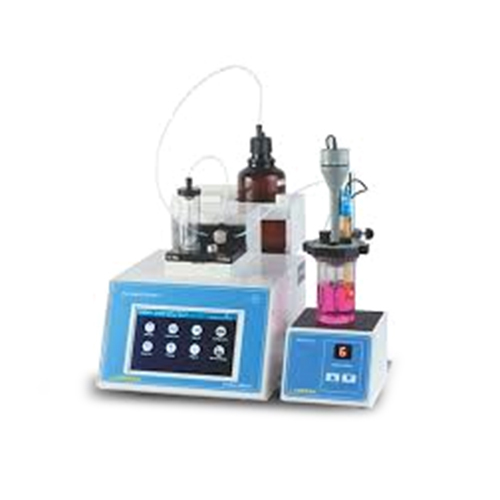
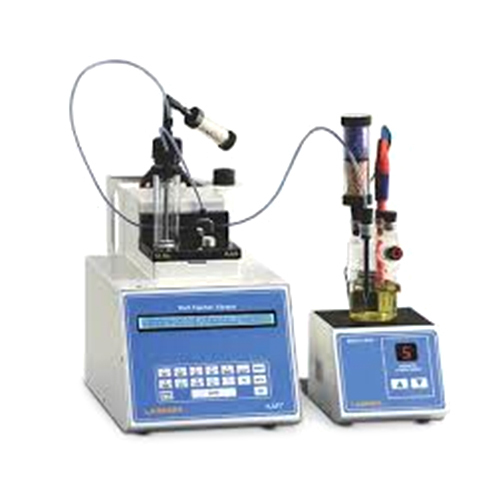
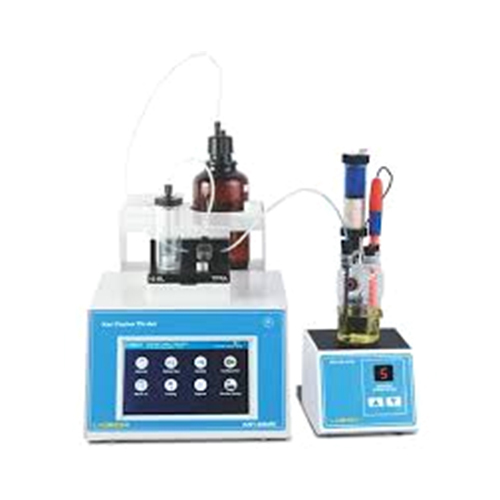
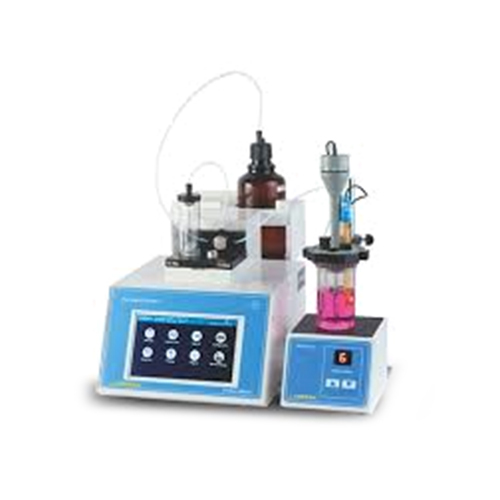
About Potentiometric Auto Titrator Titra+
Standard Features of Automatic Titrator
- Advanced Microcontroller-Based Design: User-friendly, state-of-the-art product design with alphanumeric splash waterproof polyester soft keys for the keyboard. User-interactive software in dialogue mode for ease of operation, with protection against invalid entries.
- Vortex Stirrer: For vigorous and homogeneous stirring with a specially designed glass propeller for total chemical inertness.
- Quick Interchangeable Burette Assemblies: Imported burette assemblies with intelligent recognition for volume size. Burette factor for dispensing corrections is available for true endpoint calculations.
- Composite Differential Electrode Amplifier Unit: For potentiometric and voltametric/KF titrations, with connectivity to various electrodes. Temperature sensor with 4-line measurement technique ensures correct temperature indication.
- Three Standardized Titration Modes: Incremental, equilibrium, and cut-off by pH mode to perform almost all types of titration. The instrument prints the appropriate electrode type based on the selected titration method.
- Measured Variable Display: During titration, the measured variable (electrode potential or pH value) is displayed along with the dispensed volume and number of End Points (EP) detected.
- User-Selectable End Point (EP) Evaluation: Up to 9 EP during the run, with calculation by first, last, largest, all, or selected EP, with results displayed and printed.
- Alphanumeric Entries: Sample name, titrant name, identification number, date, and electrode type used for authentication. Includes factory-entered customer name and instrument serial number on report printouts, ensuring GLP compliance.
- Dispenser Functionality: Can be used as a dispenser for fixed-volume dosing or dilution, allowing for manual titration with user-defined doses and mV indication.
- Pre-Dispense Facility: Selectable dose and time for quick titrant addition without disturbing the titration trend.
- Automatic Evaluation of Molarity: For titrant standardization, with storage of 20 molarities and retrieval for calculation.
- Compliance: ASTM D664, D2896 & D4739 for TAN and TBN analysis for oil samples.
- Titrant Temperature Factor: For volume correction.
- Result Recalculation Facility: Printouts available in different units such as molarity, factor, % assay (wt), % volume (ml), ppm, mg/l, mg/g, ml/g, g/l, meq/l, mol/kg, TAN, & TBN for oil samples.
- Reprocessing of Threshold and EP Calculation: Recalculation of EP without performing a new run.
- Statistical Function: Run selectivity to calculate mean, standard deviation (S.D.), relative standard deviation (R.S.D.), and coefficient of variation (C.V.) for the last 10 repeat run results, which can be viewed or printed.
User-Programmed Selectivity for Report Format: Complying with GLP requirements:
- Report with parameters and results.
- Data table with mV, pH, mV, mV/ml, 2nd derivative, and volume (l).
- Graphical report showing mV vs. l titration curve.
- Graphical report of 1st derivative graph vs. l titration curve.
- Graphical report of 2nd derivative curve.
- Report of method parameters for 50 methods.
- Condensed report of titration parameters and results.
- Auto evaluation report for multi-EP samples (EP1, EP2-EP1, etc.).
- Report Access: Reports can be obtained even after resetting/power off/power failure.
- Real-Time Clock (RTC): For time display and report printout with runtime indication.
- Balance Interface: Direct transfer of sample weight.
- Two-Tier Password Protection: Admin and user-level protection for method editing.
- Conversion to Karl Fischer Titrations: TITRA can be converted for Karl Fischer titrations by changing the burette assembly. All specifications of LABINDIA Karl Fischer Titrator are applicable.
Accurate and Efficient TitrationTitra+ brings precision and ease of use to laboratory titrations, whether performing acid-base, redox, or potentiometric processes. The fully automatic system ensures highly reproducible results, supported by programmable methods and an intuitive digital display. Its built-in high sensitivity electrode input detects minute changes, making it suited for demanding analytical environments.
Designed for Laboratory VersatilityWith its robust, corrosion-resistant build and compact dimensions (400 x 320 x 140 mm), the Titra+ adapts easily to various laboratory settings. The magnetic stirrer offers adjustable speed to optimize mixing, and multiple burette capacities allow flexibility for different sample sizes. Its chemical-proof construction ensures long-term performance even with aggressive reagents.
Easy Connectivity and Data ManagementThe Titra+ simplifies data handling with RS232/USB connectivity for direct PC interfacing, and inbuilt printer support for immediate report generation. The 100-result memory capacity offers ample space for routine analyses, supporting efficient, error-free workflow and facilitating QA/QC in professional environments.
FAQ's of Potentiometric Auto Titrator Titra+:
Q: How does the Titra+ Potentiometric Auto Titrator achieve high titration accuracy?
A: The Titra+ utilizes a burette with 1/20000 resolution and high-sensitivity electrode input, achieving measurement accuracy of 0.1%. The magnetic stirrer ensures sample homogeneity, while programmable titration methods further enhance repeatability and precision.
Q: What titration modes are supported by the Titra+ and in which laboratory applications can it be used?
A: The Titra+ supports potentiometric, acid-base, and redox titration modes. It is ideal for laboratories, research institutions, and quality control environments requiring precise analytical measurements for chemical, pharmaceutical, food, or environmental samples.
Q: When is it recommended to use the Titra+ automated titrator instead of a manual titration method?
A: Use the Titra+ when high accuracy, reproducibility, and data storage are critical, such as during quantitative analyses in research or QC labs. Its automation reduces user errors, increases throughput, and ensures consistency across multiple measurements compared to manual titration.
Q: Where can the data from the Titra+ titrator be accessed and transferred?
A: Results can be directly accessed through the digital LCD display or printed using the inbuilt printer provision. For digital archiving or further analysis, data can be transferred to a PC using the RS232 or USB interface.
Q: What is the process for conducting a titration using the Titra+?
A: Set up the burette with the sample and select the desired titration mode. Program the method parameters using the control unit. The titrator automatically dispenses titrant, monitors the reaction via the electrode, and records the endpoint. Results are stored in memory and can be printed or exported.
Q: What are the benefits of using Titra+ in routine laboratory analyses?
A: Titra+ streamlines the titration workflow, enhances reproducibility, and minimizes manual labor. Its data management features allow quick reporting and traceability, while robust chemical-proof materials provide durability in challenging lab environments.

 Send Inquiry



 Send Inquiry

 Send Inquiry
 English
 Spanish
 French
 German
 Italian
 Chinese (Simplified)
 Japanese
 Korean
 Arabic
 Portuguese